

To translate, culturally adapt, and validate the original Pediatric Refractive Error Profile (PREP) questionnaire into Spanish, enabling assessment of vision-related quality of life (VR-QoL) in children wearing spectacles.
MethodsThe PREP was translated and adapted following a five-step protocol. A sample of 124 Spanish children aged 8–14 years with refractive errors (myopia, hyperopia, and/or astigmatism) and ≥1 year of spectacle use completed the Spanish version. Internal consistency was assessed using Cronbach’s alpha; test–retest reliability was evaluated in 18 children using intraclass correlation coefficients (ICC). Validity was examined through item–scale correlations, inter-scale correlations (construct validity), and associations with clinical visual parameters and a Visual Analogue Scale (VAS) measuring subjective experience (concurrent validity).
ResultsAll participants completed the questionnaire without difficulties. Cronbach’s alpha ranged from 0.754 to 0.918 across the 10 scales. ICC values ranged from 0.541 to 0.921, indicating moderate to excellent reliability. Item–scale correlations exceeded 0.40, and construct validity was supported by moderate to strong inter-scale associations. Significant correlations were found between visual acuity and the vision-related scales, and between VAS scores and the appearance, satisfaction, and activities scales. Children with visual acuity deficits showed significantly lower scores in several domains.
ConclusionsThe Spanish version of the PREP questionnaire shows preliminary evidence of reliability and validity for assessing vision-related quality of life in children wearing spectacles. However, further studies are needed to confirm its psychometric properties using more comprehensive validation approaches.
Refractive errors are highly prevalent among school age children and represent a significant public health concern. In 2025, the prevalence of clinically significant refractive error in Europe was estimated to be approximately 18%, considering myopia ≥ −0.50D, hyperopia ≥ +2.00D, and astigmatism ≥ −1.00D.1 In Spain, the prevalence of myopia in children between 5 and 7 years of age increased significantly between 2016 and 2020, according to a 2021 study that included children from various Autonomous Communities.2 In second and sixth grade students in the Community of Madrid, the prevalence of myopia was 6.5% and 18.7%, respectively.3 While myopia continues to increase worldwide, hyperopia and astigmatism do not show significant changes in trend4–6 although some studies show that the prevalence of astigmatism has increased after the pandemic in children between 6 and 8 years of age in Hong Kong.7 The etiology of myopia has been shown to be associated with both genetic and environmental factors8,9 just as uncorrected hyperopia and astigmatism are associated with poor academic performance.10–12
For many children, spectacles are the primary and most accessible form of optical correction, and their use could influence their self-esteem.13
Assessing vision related quality of life (VR QoL) in pediatric populations is therefore essential. Several instruments have been developed for this purpose, but each presents important limitations. The Self Perception Profile for Children (SPPC)14 evaluates self-concept, it can guide interventions to improve self-esteem and emotional well-being, but does not address visual performance or the child’s experience with spectacles. The Children’s Visual Function Questionnaire (CVFQ)15 focuses on general health and family impact, is intended for children under eight years of age, and must be completed by parents or caregivers. Consequently, there remains a need for a child reported instrument specifically designed for school aged children who wear spectacles.
The Pediatric Refractive Error Profile (PREP) was developed to measure VR QoL in children related to refractive error correction, regardless of the degree of ametropia and has been used in multiple pediatric research settings since its first appearance in the ACHIEVE study in 2006.16–19 A modified version was later explored to identify factors associated with spectacle wear.20 Although a revised version (PREP2) has been published, it was primarily developed and validated in samples of myopic children who were contact lens wearers.21–23 This version consists of 56 questions instead of the 26 in the original PREP, making it more difficult to administer to children due to its length. Furthermore, its structure and approach make it less suitable for assessing the general population of children who rely on spectacles to correct myopia, hyperopia, or astigmatism, since it does not incorporate specific items on academic outcomes (items 12 and 14) and instead includes many questions related to sports and outdoor activities where wearing spectacles would be more uncomfortable compared to other methods of optical correction, as has already been demonstrated.24
In Spain, the original PREP has been used in several studies comparing VR-QoL among children wearing different types of optical corrections.24,25 However, the absence of a formal linguistic and cultural adaptation raises concerns regarding semantic equivalence, interpretability, and cross-study comparability. A rigorous translation and validation process is therefore necessary to ensure that the instrument is appropriate for Spanish-speaking pediatric populations and can be reliably used in both clinical and research contexts.26
Given the lack of validated VR-QoL questionnaires for Spanish-speaking children who wear spectacles, and the need for an instrument applicable to all major refractive errors, this study aimed to translate, culturally adapt, and provide an initial validation of the original PREP questionnaire for use in Spain. We evaluated its feasibility, reliability, and validity in a cohort of children aged 8–14 years, providing a practical and clinically relevant tool for assessing the impact of refractive errors and spectacle wear on daily life. Given the exploratory nature of this study, we aimed to provide an initial assessment of its psychometric performance in a Spanish pediatric population.
Materials and methodsTranslation and cultural adaptation of the PREP questionnairePREP is a questionnaire designed to assess the aspects of the vision-related quality of life in children with refractive error. It comprises 26 items distributed across 10 scales and a global score: “overall vision”, “distance vision”, “near vision”, “symptoms”, “physical appearance”, “satisfaction”, “physical exercise (activities)”, “academic results”, “handling”, “peer perceptions”.
The translation and cultural adaptation process followed the methodology proposed by Ramada-Rodilla et al.26 ensuring semantic, idiomatic, conceptual, and experiential equivalence between the original English version and the Spanish adaptation. The process involved five steps:
- •
Step 1: Forward translation. Two independent bilingual translators, both native Spanish speakers and with no prior exposure to the PREP questionnaire, produced two forward translations. One translator had expertise in vision science, while the other had no clinical background, ensuring both technical and lay perspectives.
- •
Step 2: Synthesis of translations. The two translations were compared to identify discrepancies and produce a single reconciled version. In case of disagreement, a meeting was held with the research team and both translators to reach a consensus. The research team consisted of two optometrists with clinical experience in pediatric refractive error, and a methodologist with expertise in questionnaire validation.
- •
Step 3: Back translation. The reconciled Spanish version was translated back into English by two independent bilingual translators whose native language is English. One was a vision care professional, and both were unfamiliar with the original questionnaire. The translators documented any difficulties encountered and semantic or conceptual differences between the original and back-translated versions were evaluated.
- •
Step 4. Expert committee review. A multidisciplinary committee, comprising two vision care professionals, a methodologist, and all participant translators, reviewed the forward translations (step 1), the synthesized version (step 2), and back translations (step 3). Discrepancies were discussed to produce a culturally adapted Spanish version.
- •
Step 5. Pre-test. The pre-final version was administered to 15 Spanish-speaking adults (parents of children aged 8–14 years). After completing the questionnaire, they participated in structured cognitive debriefing interviews to identify difficulties in comprehension, wording, or cultural relevance. Items flagged by ≥15% of participants were revised. The revised version was then tested in a second group of 15 Spanish-speaking adults meeting the same inclusion criteria, who again completed the questionnaire and participated in cognitive debriefing to confirm clarity and comprehension.
To assess the reliability and validity of the Spanish version of the PREP, a sample of 124 children was enrolled. Inclusion criteria were aged between 8 and 14 years; diagnosis of refractive error (myopia, hyperopia, and/or astigmatism); and spectacle use for at least one year. The children who participated in the study were randomly selected from those attending a pediatric optometry appointment at a health center affiliated with the Infanta Sofía Hospital. Children accompanied by someone other than their legal guardian (usually grandparents) and those whose native language was not Spanish were excluded. In some cases, children were excluded simply due to a significant delay in their appointment schedule. Exclusion criteria included systemic diseases (diabetes, neurological disorders, children with attention deficit disorder or speech difficulties) or ocular disease (retinopathies, corneal pathology such as ulcers or dystropia, glaucoma, eye surgery, amblyopia, color blindness) and refusal to provide consent. Children with binocular vision disorders such as convergence insufficiency, stereopsis failure, or strabismus manifest with spectacles were excluded.
This study was conducted in accordance with the ethical principles outlined in the Declaration of Helsinki and was approved by the Infanta Sofía Hospital Research Ethics Committee (reference code 062/2023). Informed consent was obtained from all legal guardians.
The children were evaluated at Infanta Sofía University Hospital, Madrid, Spain, from June 2023 to November 2024. All participants underwent a comprehensive eye examination, including monocular and binocular visual acuity (uncorrected and corrected), subjective refraction, and ocular alignment assessment using distance and near cover tests with and without spectacles. Distance and near visual acuity were measured monocularly and binocularly using standardized decimal charts. Testing was performed at 6 meters for distance and 40 cm for near, under habitual lighting conditions. Ocular alignment was assessed using the unilateral and alternating cover test at distance (6 m) and near (40 cm), with and without habitual correction. The children were already seeing with their spectacles. In addition, the near point of convergence was measured and the Titmus stereopsis test was performed. The cycloplegic dilation performed in previous checkups before the spectacles prescription was taken into account when determining the prescription. Refractive status was classified using spherical equivalent (SE = sphere + 0.50 × cylinder) of the right eye, following the predefined rule used in previous pediatric refractive error studies, as: hyperopia (SE ≥ +0.50 D), myopia (SE ≤ –0.50 D), and emmetropia (SE between –0.50 D and +0.50 D). Astigmatism was defined as a cylindrical refractive error of ≤–0.75 D in either eye.
The ophthalmological examination consisted of biomicroscopy to detect anterior segment abnormalities and a dilated fundus examination to detect posterior segment pathology. This examination was performed during the first visit when patients came in to obtain a spectacles prescription, and their pupils were dilated with cycloplegic.
Children then completed the Spanish PREP questionnaire independently, without parental assistance. They responded to 26 statements using a five-point Likert scale: "strongly disagree," "disagree," "neutral," "agree," or "strongly agree." We gave them the test and explained that they should read each question and answer according to how much they agreed. For example, in the first question, "I like wearing my spectacles," they were asked to think about it: if they loved wearing their spectacles, they should write "completely agree"; if they hated or disliked wearing their spectacles, they should write "completely disagree"; if they were indifferent or didn't know, they should answer "neither agree nor disagree" (neutral); and if they were happy or unhappy but not excessively so, they should simply answer "agree" or "disagree." The completed questionnaire was immediately handed to the examiner.
The room and the person administering and explaining the test are always the same, so there is no variation in the lighting or the way the questionnaire is presented.
A researcher not involved in data analysis conducted data collection for the PREP questionnaire.
Responses were scored from 1 (negative) to 5 (positive), then scaled from 0 (poor quality of life) to 100 (excellent quality of life) following Andersen et al. (20).
To evaluate test-retest reliability, a random subsample of 18 children completed a second administration of the questionnaire within the subsequent three months. They also completed a single-item Visual Analogue Scale (VAS) rating their experience of wearing spectacles from 0 (very poor) to 100 (excellent).
Statistical analysesSociodemographic characteristics, visual examination results, and responses to the PREP questionnaire—both at the item and scale levels, as well as the total score—were summarized using means ± standard deviations (SD) or medians and interquartile ranges [Q1, Q3] for continuous variables depending on the distribution of the data (assessed using the Shapiro–Wilk tests) or using absolute (n) and relative (%) frequencies for categorical variables.
The reliability of the questionnaire was evaluated through two approaches: (i) Internal consistency was assessed using Cronbach’s alpha coefficient for each scale (values ≥ 0.70 were considered acceptable), as an initial indicator of reliability.; and (ii) test–retest reliability was examined using the intraclass correlation coefficient (ICC in a subsample of participants who completed the questionnaire on two separate occasions (values above 0.70 were considered acceptable).
Validity was assessed through several methods: (i) item discriminant validity -examined by analyzing item–scale correlations, with the expectation that each item would correlate more strongly with its corresponding scale than with other scales-; (ii) construct validity -evaluated using Spearman’s correlation coefficients between the different scales of the questionnaire, with moderate to strong correlations expected among conceptually related domains-; and (iii) concurrent validity -assessed by calculating Spearman’s correlations between questionnaire scores and (1) clinical visual parameters (monocular and binocular corrected visual acuity, and spherical equivalent of the right eye), and (2) a visual analogue scale (VAS) measuring quality of life related to wearing spectacles. Additionally, group comparisons were performed to further explore the questionnaire’s discriminative capacity. The Kruskal–Wallis test was used to compare total and scale scores among children with different refractive errors (myopia, emmetropia, hyperopia), while the Mann–Whitney U test was used to compare scores between children with and without visual acuity deficits, defined as binocular corrected visual acuity ≤ 0.8 and/or monocular corrected visual acuity ≤ 0.8 in at least one eye.
Statistical analyses were conducted using STATA BE version 17 (Stata Corp, College Station, TX, USA), with a significant level of 5% (p < 0.05).
ResultsA total of 124 subjects were enrolled in the study and completed the Spanish version of the PREP questionnaire. The mean age was 10.57 ± 1.88 years, and 64 participants (51.6%) were female.
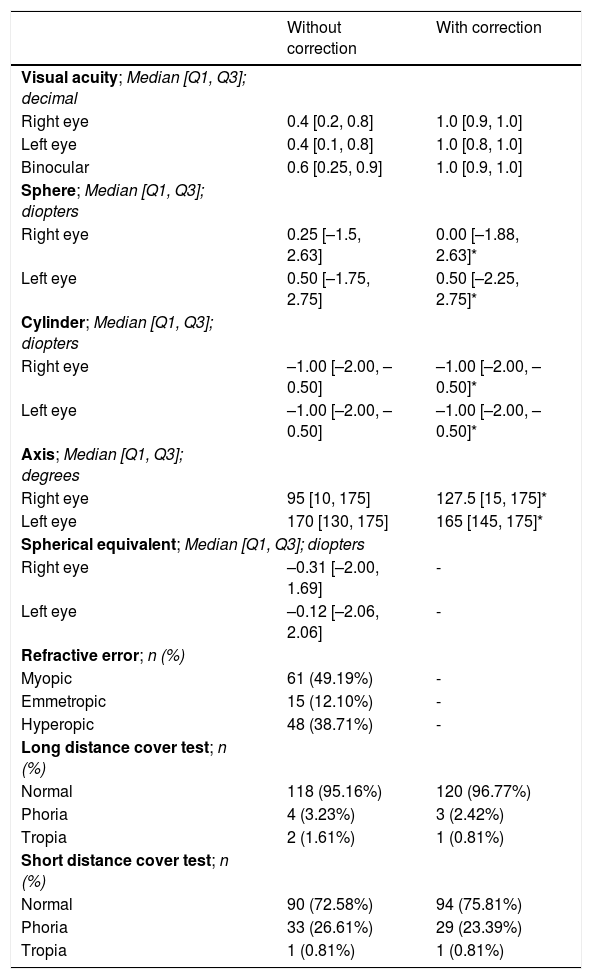
Binocular uncorrected visual acuity ranged from 0 to 1.2, with a median [Q1; Q3] of 0.6 [0.25, 0.9], while corrected visual acuity ranged from 0.3 to 1.5, with a median [Q1; Q3] of 1.0 [0.9, 1.0].
Based on the SE of the right eye, 61 children (49.19%) were classified as myopic (median [Q1; Q3] SE: –2.00 [–3.25, –1.25]), 15 children (12.1%) as emmetropic (SE: 0.00 [–0.125, 0.25]), and 48 children (38.71%) as hyperopic (SE: 2.25 [1.44, 3.69]). A detailed summary of the visual examination findings, including refractive status, visual acuity, and cover test results, is presented in Table 1.
Summary of visual examination in the 124 children studied.
| Without correction | With correction | |
|---|---|---|
| Visual acuity; Median [Q1, Q3]; decimal | ||
| Right eye | 0.4 [0.2, 0.8] | 1.0 [0.9, 1.0] |
| Left eye | 0.4 [0.1, 0.8] | 1.0 [0.8, 1.0] |
| Binocular | 0.6 [0.25, 0.9] | 1.0 [0.9, 1.0] |
| Sphere; Median [Q1, Q3]; diopters | ||
| Right eye | 0.25 [–1.5, 2.63] | 0.00 [–1.88, 2.63]* |
| Left eye | 0.50 [–1.75, 2.75] | 0.50 [–2.25, 2.75]* |
| Cylinder; Median [Q1, Q3]; diopters | ||
| Right eye | –1.00 [–2.00, –0.50] | –1.00 [–2.00, –0.50]* |
| Left eye | –1.00 [–2.00, –0.50] | –1.00 [–2.00, –0.50]* |
| Axis; Median [Q1, Q3]; degrees | ||
| Right eye | 95 [10, 175] | 127.5 [15, 175]* |
| Left eye | 170 [130, 175] | 165 [145, 175]* |
| Spherical equivalent; Median [Q1, Q3]; diopters | ||
| Right eye | –0.31 [–2.00, 1.69] | - |
| Left eye | –0.12 [–2.06, 2.06] | - |
| Refractive error; n (%) | ||
| Myopic | 61 (49.19%) | - |
| Emmetropic | 15 (12.10%) | - |
| Hyperopic | 48 (38.71%) | - |
| Long distance cover test; n (%) | ||
| Normal | 118 (95.16%) | 120 (96.77%) |
| Phoria | 4 (3.23%) | 3 (2.42%) |
| Tropia | 2 (1.61%) | 1 (0.81%) |
| Short distance cover test; n (%) | ||
| Normal | 90 (72.58%) | 94 (75.81%) |
| Phoria | 33 (26.61%) | 29 (23.39%) |
| Tropia | 1 (0.81%) | 1 (0.81%) |
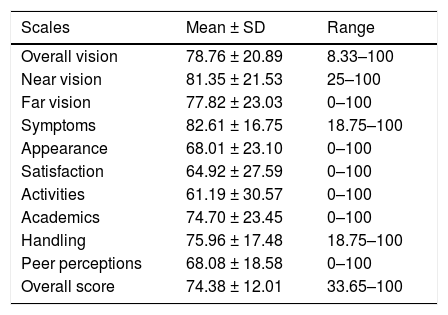
All 124 participants completed the questionnaire without any difficulties, and none of the items were left unanswered. Descriptive statistics for the scale scores are presented in Table 2.
Descriptive statistics for scale scores.
The responses for each item of the Spanish version of the PREP questionnaire from the 124 children included in the study are shown in Supplementary Table 1.
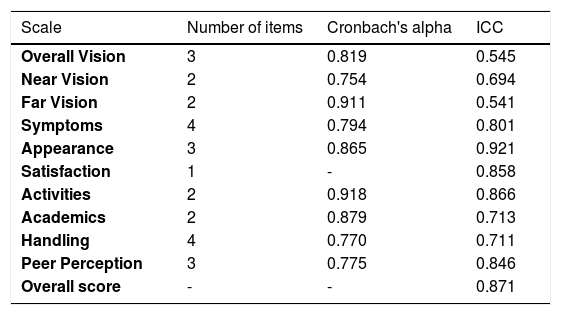
ReliabilityThe internal consistency of the questionnaire was adequate for the 10 scales of the PREP. Cronbach’s alpha coefficients ranged from 0.754 (Near Vision) to 0.912 (Activities), indicating good to excellent reliability. All the scales exceeded the commonly accepted threshold of 0.70 (Table 3). The Satisfaction scale could not be evaluated, as it consisted of a single item.
Internal consistency and test–retest reliability of the scales.
ICC: intraclass correlation coefficient.
For most scales, test–retest reliability was adequate. The average time elapsed between test and retest was 42.2 ± 18.1 days (range: 11–91 days). The intraclass correlation coefficients (ICCs) ranged from 0.541 (Far Vision) to 0.921(Appearance), indicating moderate to excellent temporal reliability (Table 3).
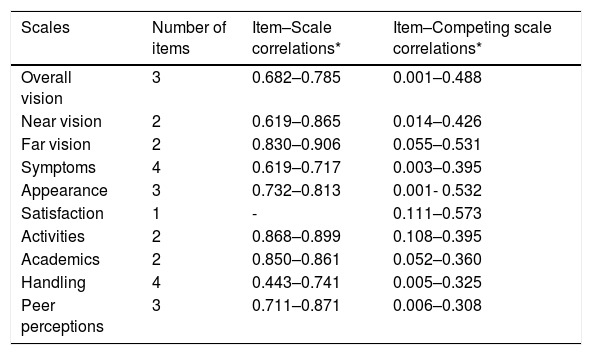
ValidityThe item–scale correlation coefficients ranged from 0.443 to 0.906, with all items showing correlations above 0.40, indicating generally good item internal consistency (Table 4). Importantly, all items correlated more strongly with their corresponding scale than with competing scales, supporting the discriminant validity of the instrument.
Discriminant validity of the questionnaire items: Item–Scale and Item–Competing Scale Correlation.
| Scales | Number of items | Item–Scale correlations* | Item–Competing scale correlations* |
|---|---|---|---|
| Overall vision | 3 | 0.682–0.785 | 0.001–0.488 |
| Near vision | 2 | 0.619–0.865 | 0.014–0.426 |
| Far vision | 2 | 0.830–0.906 | 0.055–0.531 |
| Symptoms | 4 | 0.619–0.717 | 0.003–0.395 |
| Appearance | 3 | 0.732–0.813 | 0.001- 0.532 |
| Satisfaction | 1 | - | 0.111–0.573 |
| Activities | 2 | 0.868–0.899 | 0.108–0.395 |
| Academics | 2 | 0.850–0.861 | 0.052–0.360 |
| Handling | 4 | 0.443–0.741 | 0.005–0.325 |
| Peer perceptions | 3 | 0.711–0.871 | 0.006–0.308 |
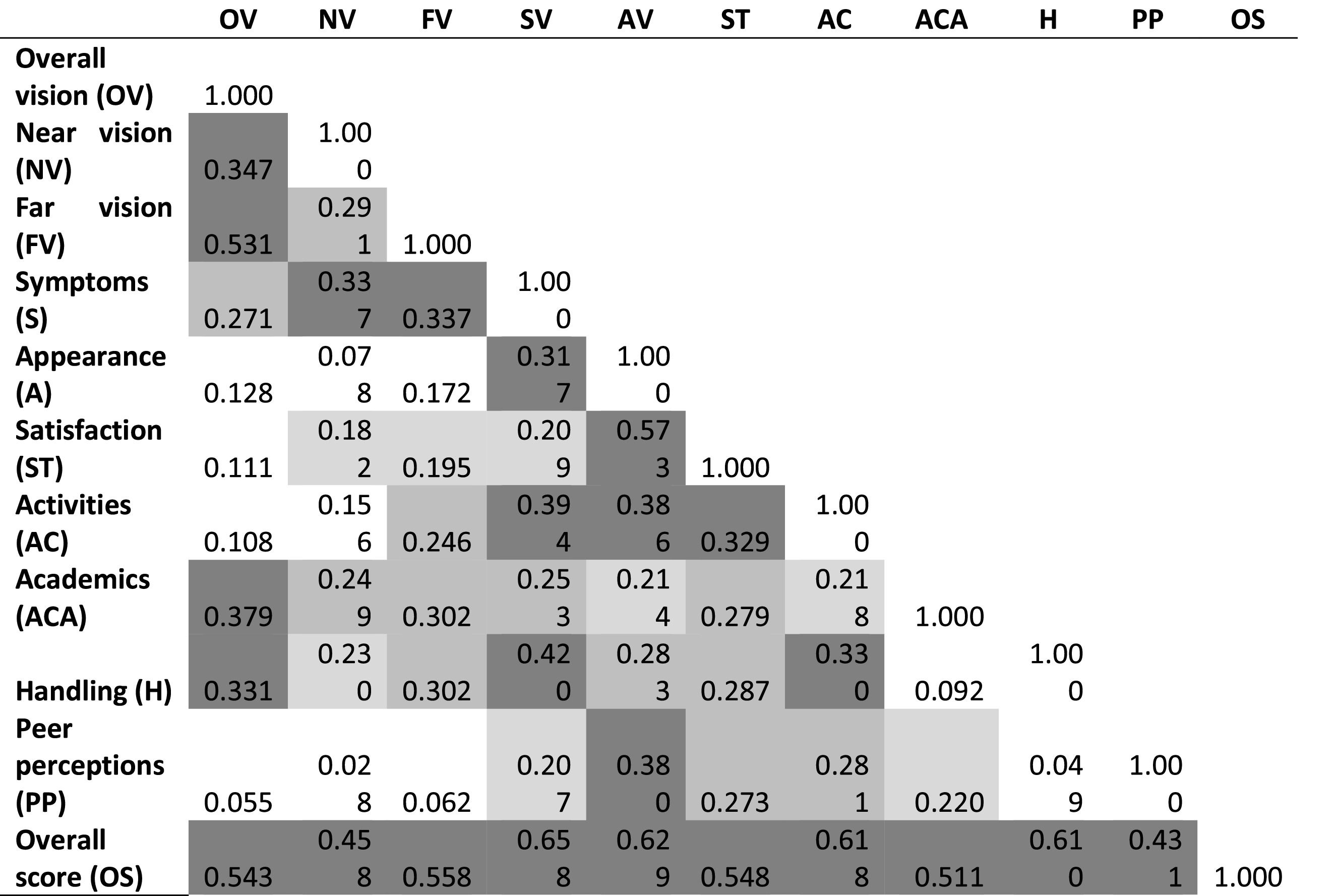
Table 5 shows the Spearman’s correlation coefficients between the scales of the Spanish version of the PREP questionnaire. Moderate to strong positive correlations were observed between most scales, particularly between Overall Vision and Far Vision, and between Appearance and Satisfaction—as well as between individual scales and the Overall score (notably for Symptoms, Handling, and Activities). These findings support the construct validity of the instrument, reflecting coherent relationships among conceptually related domains.
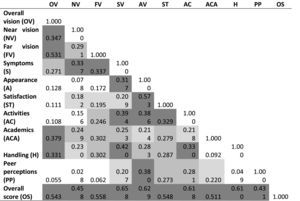
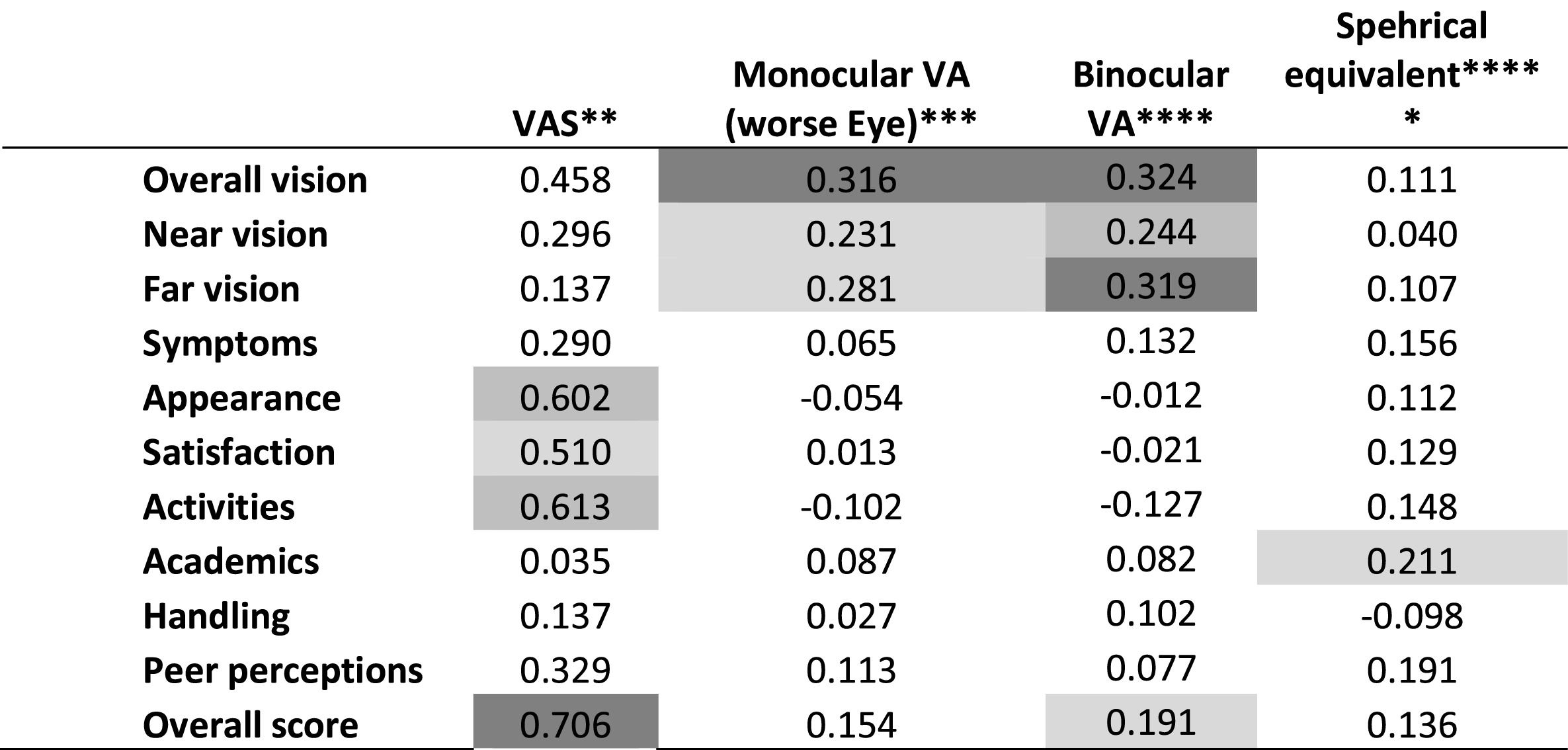
Table 6 shows the Spearman correlation coefficients between the scales, the overall score, and the visual examination results in the 124 children. Although the overall score showed either non-significant or weak correlations with the spherical equivalent and with monocular or binocular corrected visual acuity, moderate and statistically significant correlations were observed between monocular and binocular visual acuity and the overall vision, near vision, and far vision scales. Additionally, the spherical equivalent was significantly correlated with the academic scale score. Moreover, in a smaller subset of participants who responded to the question “How do you feel wearing spectacles?” using a Visual Analogue Scale (VAS) ranging from 0 (AWFUL: Very poor quality of life, worst imaginable) to 100 (EXCELLENT: Very high quality of life, best imaginable), a strong positive correlation was found between the VAS score and the questionnaire’s overall score, as well as moderate to strong correlations with the appearance, satisfaction, and activities scales. All significant correlations were in the expected direction and support the concurrent validity of the Spanish version of the PREP questionnaire.
Concurrent validity: Correlations* between scales and overall scores with VAS** and visual examination parameters (***, ****; *****).
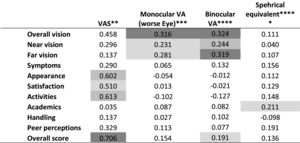
* Spearman's correlation coefficients between scales and overall scores and visual exam parameters. Coefficients are shaded according to significance level: p < 0.001 (darkest), p < 0.01, p < 0.05, and P ≥ 0.05 (no shading).
** Visual Analogue Scale (VAS) to the question “How do you feel wearing spectacles?” (0 = AWFUL: Very poor quality of life, worst imaginable; 100 = EXCELLENT: Very high quality of life, best imaginable).
***Monocular Visual Acuity (VA) with correction in the worse eye (i.e., the eye with the lowest acuity, whether right or left).
****Binocular Visual Acuity (VA) with correction.
*****Spherical equivalet (sphere + 0.5 Cylinder) of the right eye (diopters).
Finally, the validity of the questionnaire was confirmed through group comparisons. Specifically, children with VA deficit, defined as binocular VA with correction ≤ 0.8 and/or monocular VA with correction ≤ 0.8 in either eye—were compared to children with normal VA (binocular VA > 0.8 and monocular VA > 0.8 in both eyes). Statistically significant differences were observed in several scales of the questionnaire, with lower scores among children with VA deficits, in overall vision (p < 0.001), near vision (p = 0.002), far vision (p = 0.004), and academic performance (p = 0.029). The overall score was also significantly lower in children with VA deficits compared to those with normal VA (70.2 [64.4, 78.8] vs. 76.9 [63.3, 84.6], p = 0.027). In contrast, no significant differences were found in the overall score or in individual scales among children with myopia, hyperopia, or emmetropia. However, a non-significant trend was observed in the far vision scale (p = 0.080), where myopic children reported lower scores (75 [50, 87.5]) compared to emmetropic (100 [75, 100]) and hyperopic children (87.5 [75, 100]).
DiscussionThis study provides the first Spanish translation, cross-cultural adaptation, and initial validation of the Pediatric Refractive Error Profile (PREP), a reliable, valid, and repeatable instrument specifically designed to assess vision-related quality of life (VR-QoL) in children wearing spectacles. Unlike previous studies that focused exclusively on myopic children, our sample included children with myopia, hyperopia, and astigmatism, broadening the applicability of the tool to the general pediatric population.
Given the rising prevalence of refractive errors, particularly myopia,4 among school-aged children, the need for culturally adapted instruments to evaluate the impact of spectacle wear on children's daily lives is increasingly important. The Spanish PREP enables clinicians and researchers to better understand how children perceive their visual experience and psychosocial well-being, regardless of refractive diagnosis, and to identify those who may benefit from alternative correction strategies.
Our findings demonstrated strong internal consistency across the 10 scales of the PREP, with Cronbach's alpha coefficient ranging from 0.754 (near vision) to 0.918 (activities), exceeding the commonly accepted threshold of 0.70. Although Cronbach’s alpha was used as a measure of internal consistency, it is recognized that this index has important limitations and may overestimate reliability. Contemporary psychometric standards recommend the use of complementary approaches, such as McDonald’s omega or Rasch modeling, to more accurately assess measurement properties. However, due to sample size constraints and the exploratory nature of this study, these analyses were not performed and should be addressed in future research. These results compare favorably with those reported in the original PREP validation by Andersen et al.21 where several scales fell below this threshold. Although a revised version of the instrument (PREP2) has been validated in several languages, its development and testing were conducted almost exclusively in myopic children, many of whom were contact lens wearers, making it less suitable for evaluating the broader population of spectacle-wearing children included in our study.22–23
Even though the original PREP does not have the same number of items per scale, the reliability of the scales with more items (symptoms and management with 4 items and appearance with 3 items) closely matched those in previous studies, with minimal differences (0.020, 0.061 and 0.021 points between the results of the Chinese version and ours). The Satisfaction scale, composed of a single item (“I like wearing spectacles”), could not be evaluated and is absent in PREP2.
Test–retest reliability was also acceptable, with ICC values ranging from moderate to excellent. The lower reliability observed in the three vision-related scales (ICC < 0.70) may be attributed to the longer interval between test administrations (mean: 42 days), during which changes in prescription or spectacle use may have occurred. In contrast, previous validation studies used a 7-day interval. This variability in the retest interval represents a limitation of the study and reflects the practical constraints of scheduling pediatric follow-up visits in a real clinical setting. Despite this, the Appearance scale showed excellent temporal stability (ICC = 0.921), consistent with findings from the Chinese version. The variability in the retest interval and the relatively small subsample may have affected the reliability estimates and should be considered when interpreting these results.
Discriminate validity was confirmed through items using Spearman's correlation coefficient, with all items exceeding 0.4 and correlating more strongly with their respective scales than with others. This supports the structural integrity of the questionnaire and affirms that each item effectively measures its intended domain.
Construct validity was supported by moderate to strong positive correlations between the general vision, distance vision, and appearance satisfaction scales. These associations were coherent with the conceptual structure of the original PREP, which separates distance and near vision into distinct domains, an approach particularly relevant for children with different refractive profiles. Andersen et al. Study21 did not analyze inter-scale correlations, focusing instead on comparisons between child and tutor responses, a less direct measure of construct validity. Our findings reinforce the internal coherence of the Spanish PREP and its ability to reflect meaningful relationships between domains.
Concurrent validity was evaluated through correlations with clinical visual parameters. As expected, monocular visual acuity analyzed in the eye with the worst corrected visual acuity, and binocular visual acuity with the best correction were significantly associated with general vision, distance vision, and near vision scales, but not with symptoms, handling, or academic outcome scales. This pattern is consistent with the fact that corrected visual acuity shows limited variability in clinical samples, reducing its correlation with subjective VR-QoL measures. These results align with the Chinese validation of PREP2.
We also incorporated a Visual Analogue Scale (VAS) to assess children's subjective experience of wearing spectacles. Strong correlations were observed between VAS scores and the Appearance, Satisfaction, and Activities scales, suggesting that children’s comfort with spectacles is more closely linked to psychosocial and functional aspects than to academic performance or specific visual metrics. This highlights the importance of evaluating emotional and social dimensions when assessing pediatric VR-QoL.
Importantly, our study included children with hyperopia and astigmatism, unlike previous validations that focused solely on myopic populations. This supports the relevance of validating the original PREP, which was designed to assess VR-QoL in children wearing spectacles regardless of refractive error, and whose structure distinguishes between distance and near vision, domains particularly relevant for non-myopic refractive profiles.
Some items, especially those related to visual tasks (items 3, 6, 9, 10, 12, 14, 16, 23, and 26), may be affected by the time of day they are administered (the administration time ranges from 8:30 a.m. (when the children are sleepier) to 2:00 p.m. (when they are more active and hungry). The advantage of PREP over PREP2 is that it is a much shorter questionnaire.
The general vision scale would be equivalent to PREP2. On the other hand, children with corrected visual acuity equal to or less than 0.8 in one or both eyes reported significantly lower scores in general vision, distance vision, and near vision scales, further validating the instrument’s sensitivity to clinical parameters.
The main limitation of this study was the small subsample used for test–retest reliability and VAS analysis. A larger sample and shorter retest interval would have strengthened the reliability estimates, as demonstrated in other PREP2 validations. Additionally, the sample size was not sufficient to perform exploratory or confirmatory factor analysis, which is often recommended for multidimensional instruments. Nonetheless, the Spanish PREP showed adequate performance within the scope of this study and appears to be a practical and clinically meaningful tool. Furthermore, a comprehensive assessment of accommodative and binocular vision parameters was not systematically integrated into the psychometric analysis, which may have limited the interpretation of the relationship between clinical variables and questionnaire outcomes.
An additional limitation is that cognitive debriefing during the pretesting phase was conducted with parents rather than directly with children from the target age group. Although all participating children completed the questionnaire independently, without assistance, and without missing items, future studies should include child-based cognitive interviews to further strengthen the cross-cultural adaptation process.
Therefore, the present findings should be interpreted as preliminary, and further studies are required to confirm the dimensional structure and robustness of the instrument using more advanced psychometric methodologies.
Accordingly, the present study should not be considered a full psychometric validation, but rather an initial step in the validation process.
In conclusion, the original PREP provides a concise and robust framework for assessing the experiences of children who wear spectacles across diverse refractive errors. With its validated Spanish version, clinicians and researchers now have access to a culturally adapted instrument for evaluating vision-related quality of life in Spanish-speaking children. The Spanish version of the PREP questionnaire provides initial evidence of reliability and validity and appears to be a promising tool for clinical and research use. However, further validation using more comprehensive psychometric approaches is required to confirm its measurement properties.
Ethics statementThis study was conducted in accordance with the principles of the Declaration of Helsinki. Approval was granted by the Ethics Committee of Infanta Sofia Hospital (July 2023; 062/2023).
Funding statementThe authors declare that no funding was received for this study.
No conflicts of interest exist for any of the authors.
We would like to express our sincere gratitude to all the children who participated in this study and to their parents and legal guardians for their trust and collaboration. We are also deeply thankful to the Infanta Sofía University Hospital and its dedicated team of professionals, whose support and commitment were essential to the successful development and implementation of this research.